
AI-Driven RCM & Denials
Home Health Denial Trends in 2026: What the Data Shows
There is no single, centralized "home health denial rate" published for 2026 the way there is for hospital claims, but three real, documented data threads paint a consistent picture: Medicare Advantage post-acute care denials are drawing new federal scrutiny, the specific reasons home health claims get denied have stayed remarkably consistent for years, and the broader healthcare claim-denial climate is getting worse, not better. This article works through what each of those threads actually shows, with sources, rather than citing a single home-health-specific percentage that doesn't yet exist in a verifiable, centralized form.
What Do We Actually Know About Home Health Denial Trends Right Now?
Home health doesn't have the kind of centralized, regularly published denial-rate benchmark that hospital claims do. Hospital revenue cycle data gets aggregated and published annually by firms like Kodiak Solutions and surveyed by Experian Health across hundreds of health systems. Home health denial data, by contrast, mostly surfaces through three narrower channels: denial-reason breakdowns published periodically by home health Medicare Administrative Contractors (MACs) like Palmetto GBA and CGS Administrators, federal oversight reports that examine Medicare Advantage post-acute care behavior, and broader healthcare-wide claim surveys that don't break results out by care setting. None of these alone tells the full 2026 home health story, but together, they show a consistent direction.
Medicare Advantage Denials for Post-Acute Care Are Under New Federal Scrutiny
In June 2026, the HHS Office of Inspector General published reports examining how the largest Medicare Advantage organizations handle prior authorization requests for post-acute care. Reviewing 19 Medicare Advantage organizations, OIG found that the three largest by enrollment, UnitedHealth Group, Humana, and CVS Health (Aetna's parent company), denied prior authorization requests for long-term care hospital and inpatient rehabilitation facility stays at higher rates than most of their peers, based on June 2024 data. A separate, independent KFF analysis of the same general landscape found that Medicare Advantage insurers deny prior authorization requests for post-acute care at substantially higher rates than their overall denial rate, and that these denials are frequently overturned on appeal, particularly for skilled nursing facility stays.
It's worth being precise about scope here: MedPAC's definition of "post-acute care" includes skilled nursing facilities, home health agencies, long-term care hospitals, and inpatient rehabilitation facilities together, but the specific 2026 OIG reports referenced above focused on LTCH and IRF requests, with a separate, earlier OIG report focused specifically on skilled nursing facility denials. A directly comparable, home-health-specific version of this federal analysis has not been published as of this writing; the clearest signal so far is that Medicare Advantage plans are facing increased scrutiny across the post-acute category home health belongs to, not a home-health-specific denial figure from OIG itself.
The Denial Reasons That Have Persisted for Home Health Claims for Years
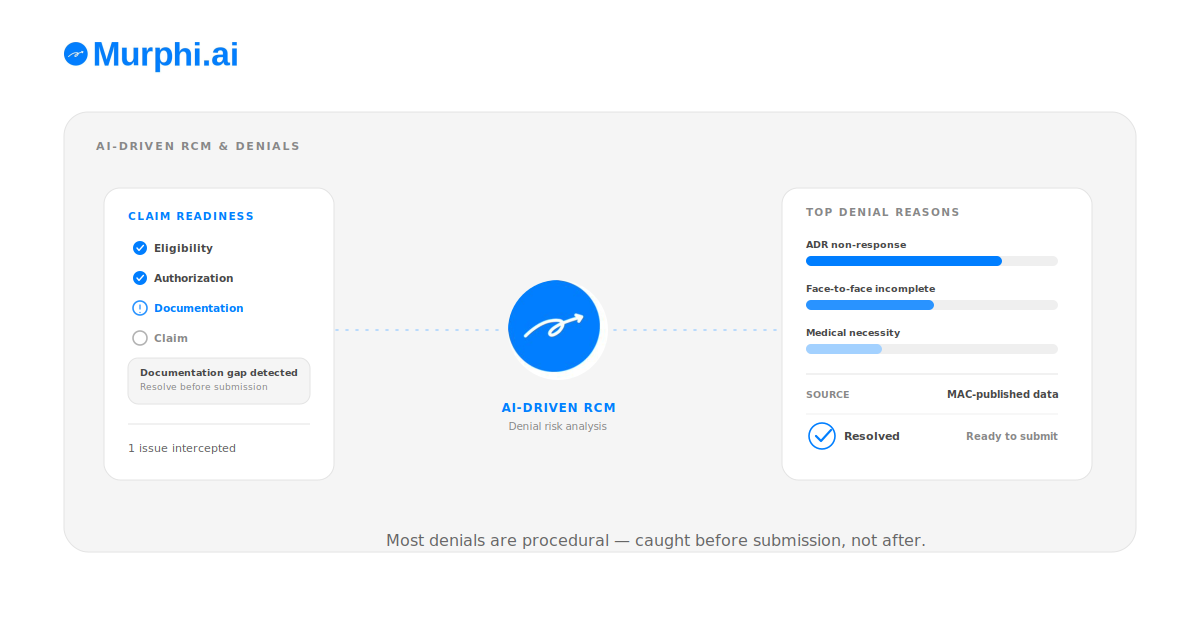
The specific reasons home health claims get denied have stayed strikingly consistent over time, according to data MACs have published periodically: non-response to Additional Documentation Requests (ADRs) and incomplete face-to-face encounter documentation are consistently the top two. Palmetto GBA, the MAC for a large home health and hospice jurisdiction, published data showing that in one quarter, denial code 56900 ("auto denial - requested records not submitted") accounted for more than half of all home health claims denied, with face-to-face encounter issues the second most common reason. A later industry summary of Palmetto GBA and CGS Administrators data similarly found ADR non-response responsible for roughly 46% of Palmetto denials and 32% of CGS denials, with face-to-face documentation issues the next most common actual reason once records were reviewed (30% for Palmetto, 17% for CGS).
The pattern behind these numbers matters as much as the numbers themselves: both leading denial reasons are procedural, not clinical. A claim gets denied because records weren't submitted in time, or because a required piece of documentation was missing, not because a reviewer determined the care itself wasn't medically necessary. That distinction matters, because it means these specific denials are largely preventable through process, not through delivering different care.
Is the Broader Healthcare Claim-Denial Climate Getting Worse?
Yes, based on industry-wide survey data, though these figures span all of healthcare, not home health specifically. Experian Health's 2025 State of Claims survey of revenue cycle leaders found that 41% of providers reported more than 10% of their claims were being denied, up from 38% in 2024 and 30% in 2022, a steady year-over-year climb. Separately, an MGMA Stat poll of medical group leaders found 60% reported claim denial rates had increased compared with the prior year. Neither survey isolates home health, but both describe the general reimbursement environment home health billing and RCM teams are operating inside, one where denial pressure has been rising broadly across healthcare for several consecutive years.
Why Home Health Is Structurally Exposed to Certain Denial Types
Home health billing has a few regulatory mechanics that create specific, well-understood denial and payment-reduction risk points:
- The Notice of Admission (NOA) has a hard five-calendar-day filing deadline. A late NOA doesn't produce a denial exactly, but it triggers a payment reduction under the same family of "process, not care" risk as the ADR and face-to-face issues above: the care was delivered, but the paperwork mechanics weren't met on time.
- PDGM's case-mix classification depends entirely on documentation. Since payment is built from OASIS functional items, coded diagnoses, and referral details, a documentation gap in any of those doesn't just risk a lower-paying case-mix group; it can also be the specific gap an ADR or medical review flags.
- Face-to-face requirements have been a top MAC denial reason since they were introduced in 2011, and remain one of the two most consistent denial drivers today.
What Can Home Health Agencies Do to Reduce Denial Risk?
Based on the patterns above, a few practices consistently reduce the most common, preventable denial types:
- Treat every ADR as time-sensitive from the day it arrives. Palmetto GBA's own guidance emphasizes monitoring claim status for review flags, submitting records well before the deadline, and following the MAC's specific submission instructions exactly, since a large share of denials trace back to records simply not being submitted in time, not to their content.
- Confirm face-to-face documentation is complete before certifying the episode, since this has been one of the top two denial reasons for over a decade.
- Keep the NOA filing on a tracked schedule, treating the five-day window as a hard deadline rather than a soft target.
- Track your own agency's denial reasons over time, rather than assuming national or MAC-wide patterns apply exactly to your claims; the procedural drivers above are common, but the specific mix varies by agency.
How Murphi Approaches Denial Risk
Murphi's AI-Driven RCM module is in active development and not yet generally available; this section reflects the planned workflow, and capabilities may change before launch. As designed, it tracks each claim across eligibility, authorization, documentation, and coding, aiming to intercept the kind of gap that leads to a denial while it's still fixable, before submission, rather than after a denial letter arrives. Planned capabilities include AI-assisted denial analysis, EOB/ERA and 837/835 reconciliation, and assistance assembling appeals when a denial does occur. Claim submission decisions remain with the agency's own team throughout.
Frequently Asked Questions
Are home health claim denials increasing in 2026?
There's no single published home-health-specific denial rate for 2026, but the surrounding evidence points the same direction: Medicare Advantage post-acute care prior authorization is under new federal scrutiny, and industry-wide claim denial surveys (not home-health-specific) show denial rates climbing for several consecutive years.
What are the most common reasons home health claims get denied?
Based on MAC-published data, non-response to Additional Documentation Requests (ADRs) and incomplete face-to-face encounter documentation have been the two most consistent top denial reasons for home health claims for over a decade. Both are procedural issues rather than clinical medical-necessity determinations.
Do Medicare Advantage plans deny post-acute care more often than traditional Medicare?
Federal oversight reports and independent analyses have found that Medicare Advantage plans deny prior authorization requests for post-acute care services at higher rates than their overall denial rate, and that a meaningful share of these denials are overturned when appealed, particularly for skilled nursing facility stays.
What is an ADR, and why does it matter for home health denials?
An Additional Documentation Request (ADR) is a request from a Medicare Administrative Contractor for medical records supporting a submitted claim. Failing to respond within the required window results in an automatic denial; MAC data has shown this to be the single most common reason home health claims get denied.
Can most home health claim denials be overturned on appeal?
Broader Medicare Advantage post-acute care data shows a meaningful share of denials are overturned on appeal when they're pursued, particularly for skilled nursing facility stays. This underscores that many denials stem from process or documentation gaps rather than a final determination that the care wasn't warranted.
Catch the Gap Before the Denial Letter
Murphi's AI-Driven RCM tracks each claim across eligibility, authorization, documentation, and coding, flagging issues while they're still fixable, not after a denial. It's launching soon.