
Revenue Assurance, Coding & OASIS Accuracy
What Is PDGM and How Does It Affect Home Health Reimbursement in 2026?
PDGM, the Patient-Driven Groupings Model, is the case-mix payment system Medicare uses to reimburse home health agencies. Instead of paying based on how many therapy visits a patient receives, PDGM sets payment for each 30-day period based on the patient's clinical and functional characteristics, as documented at referral, at OASIS assessment, and in the coding on the claim. CMS has updated PDGM's payment rates and case-mix weights for calendar year (CY) 2026, effective January 1, 2026; this guide explains how the model works and what agencies should know heading into the new year.
What Is PDGM, in Plain English?
PDGM stands for Patient-Driven Groupings Model. It's the payment model the Centers for Medicare & Medicaid Services (CMS) has used to reimburse Medicare-certified home health agencies since it took effect on January 1, 2020, under the Bipartisan Budget Act of 2018. PDGM replaced the prior payment model's reliance on the number of therapy visits delivered and instead bases payment on patient characteristics (diagnosis, functional status, and referral pattern) captured through documentation rather than visit counts.
The name reflects the intent: payment is meant to be driven by the patient's actual clinical picture, not by how much therapy was scheduled.
How Does PDGM Actually Work?
Each home health payment period is classified into one of PDGM's case-mix groups, known as Home Health Resource Groups (HHRGs), based on five variables documented in the referral, OASIS assessment, and coding:
| Variable | What It Captures |
|---|---|
| Admission Source | Whether the patient was referred from a community setting or an institutional setting (such as a hospital or SNF) in the 14 days prior |
| Timing | Whether the 30-day period is "early" (the first period in a sequence of care) or "late" (any subsequent period) |
| Clinical Grouping | The primary reason for home health care, based on the principal diagnosis reported on the claim |
| Functional Impairment Level | Low, medium, or high, based on specific OASIS items describing the patient's functional status |
| Comorbidity Adjustment | None, low, or high, based on secondary diagnoses reported that are associated with higher resource use |
A few structural points worth understanding:
- Payment periods are 30 days, not 60. PDGM replaced the previous 60-day episode with two potential 30-day payment periods per 60-day sequence of care.
- There are 432 case-mix groups (HHRGs) under PDGM, each with its own case-mix weight and Low-Utilization Payment Adjustment (LUPA) threshold, recalibrated annually by CMS.
- LUPA changes the payment type, not just the amount. If the number of visits in a 30-day period falls under that group's LUPA visit threshold, the period is paid on a per-visit basis instead of the full case-mix payment for that HHRG.
How Does PDGM Affect Home Health Reimbursement?
Reimbursement under PDGM is determined by the case-mix group a payment period is assigned to, and that assignment is entirely dependent on documentation, not on visit volume. The admission source, timing, principal diagnosis, OASIS functional responses, and coded comorbidities all feed directly into which of the 432 HHRGs a period lands in, and each HHRG carries a different case-mix weight that determines the payment rate.
This means two patients receiving clinically similar care can be reimbursed differently if their documentation captures their functional status or comorbidities differently, and a period can also fall into LUPA status, changing how it's paid entirely, based on visit count relative to that group's threshold.
What's Changing for Home Health Reimbursement in 2026?
CMS finalized the CY 2026 Home Health Prospective Payment System rule (CMS-1828-F) on November 28, 2025, effective January 1, 2026. According to CMS's own fact sheet, the rule includes:
- A net aggregate decrease of an estimated 1.3% (about $220 million) in Medicare payments to home health agencies for CY 2026 compared to CY 2025, based on the finalized policies.
- An estimated 2.4% home health payment update ($405 million increase), offset by a 0.9% decrease from the permanent behavior adjustment ($150 million), a 2.7% decrease from the temporary adjustment ($460 million), and a 0.1% decrease from the updated fixed-dollar loss ratio for outlier payments ($15 million).
- A permanent prospective adjustment of -1.023%, applied to account for the difference between CMS's assumed and actual behavior changes tied to PDGM's implementation for CYs 2020 through 2022.
- A temporary adjustment of -3.0% applied to the CY 2026 payment rate, intended to phase in the impact of that behavior-change reconciliation rather than applying it all at once.
- Recalibrated PDGM case-mix weights, updated LUPA thresholds, functional impairment levels, and comorbidity adjustment subgroups, using CY 2024 claims data, meaning the specific weight and LUPA threshold tied to any given HHRG can shift year to year even if the five classification variables themselves stay the same.
- A change to the face-to-face encounter policy, broadening who can perform the encounter to align with CARES Act language, allowing physicians, in addition to nurse practitioners, certified nurse specialists, and physician assistants, to perform the face-to-face encounter under the specified conditions.
Source: CMS, "Calendar Year (CY) 2026 Home Health Prospective Payment System Final Rule (CMS-1828-F)," Fact Sheet, November 28, 2025. Agencies should confirm the current national standardized 30-day payment rate and their own HHRG-specific case-mix weights directly against CMS's published CY 2026 rate tables before using them in financial planning, since this guide summarizes the policy changes rather than reproducing the full rate schedule.
Why Do Coding and OASIS Accuracy Matter Under PDGM?
Because case-mix group assignment is built entirely from documented information, a gap in that documentation can shift a period into a lower-paying HHRG or into LUPA status, independent of the care actually delivered. A few examples of where accuracy directly affects the payment outcome:
- OASIS functional items determine the functional impairment level (low, medium, high). Inconsistent or incomplete responses can misclassify a patient's functional status.
- Principal and secondary diagnosis coding determine the clinical grouping and comorbidity adjustment. A diagnosis that doesn't fully reflect the patient's condition, or a comorbidity that goes uncoded, can leave resource use undercounted.
- Face-to-face encounter documentation is a separate compliance requirement from PDGM's case-mix logic, but missing or incomplete F2F documentation is a common reason claims are flagged on Additional Documentation Request (ADR) review, which can delay or jeopardize payment for a period regardless of how it was coded.
- Admission source and timing need to be documented accurately at intake, since both feed directly into HHRG assignment and are difficult to correct retroactively.
None of this requires more visits or different clinical care; it requires the documentation to accurately reflect the care and the patient that were already there.
What Can Home Health Agencies Do to Improve Reimbursement Accuracy?
A few practices agencies commonly use to reduce PDGM-related documentation risk:
- Review OASIS responses for internal consistency before the assessment is locked, since conflicting answers across items can affect functional impairment scoring.
- Confirm face-to-face documentation is complete (encounter date, practitioner, and clinical justification) before the episode is certified.
- Verify the principal diagnosis supports the clinical grouping the claim will be coded to, rather than defaulting to whatever diagnosis was listed on the referral.
- Check for comorbidities that are documented but not coded, since uncoded secondary diagnoses can't contribute to the comorbidity adjustment.
- Organize the record set an ADR would ask for (referral, F2F, OASIS, and plan of care) before it's needed, not after a request arrives.
How This Connects to Murphi's Revenue Assurance Module
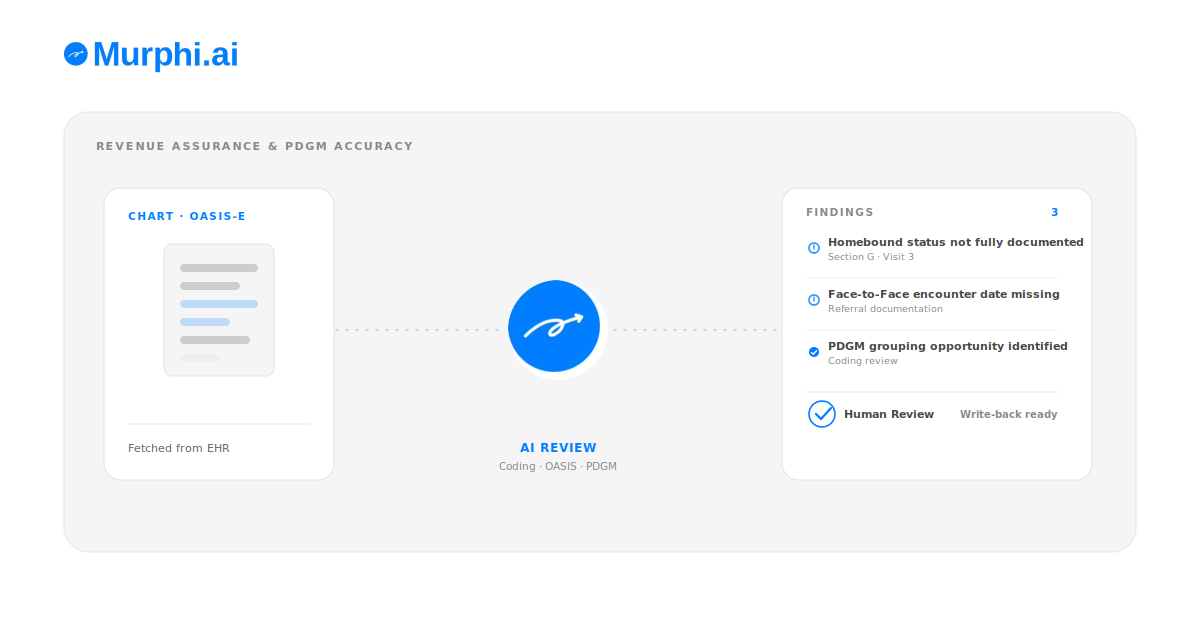
This is the same category of review Murphi's Revenue Assurance module is built to support. Murphi fetches the relevant chart (referral, face-to-face, OASIS, and plan of care) directly from an agency's existing EHR, and runs it through structured checks across five areas: coding (with levels ranging from coding-only review to coding plus OASIS plus POC), an OASIS consistency check, compliance checks (face-to-face, plan of care, and visit note review), PDGM/HHRG grouping review, and ADR documentation organization. Findings are surfaced for a reviewer to resolve, and the approved result writes back to the EHR, the same day the chart was written, rather than after a claim has already gone out or an ADR letter has arrived.
Frequently Asked Questions
What does PDGM stand for?
PDGM stands for Patient-Driven Groupings Model. It's the case-mix payment model CMS has used to reimburse Medicare home health agencies since January 1, 2020, basing payment on patient clinical and functional characteristics rather than the volume of therapy visits delivered.
How is PDGM different from the previous home health payment model?
PDGM replaced 60-day payment episodes with 30-day payment periods and removed therapy visit volume as a factor in payment. Instead, each period is classified into one of 432 case-mix groups based on admission source, timing, clinical grouping, functional impairment level, and comorbidity adjustment.
What is a LUPA under PDGM?
LUPA stands for Low-Utilization Payment Adjustment. If the number of visits delivered in a 30-day period falls below that case-mix group's visit threshold, the period is paid on a per-visit basis instead of receiving the full case-mix payment for that HHRG. LUPA thresholds are recalibrated annually.
How many PDGM case-mix groups are there?
There are 432 case-mix groups, known as Home Health Resource Groups (HHRGs), under PDGM. Each HHRG has its own case-mix weight and LUPA visit threshold, both of which CMS recalibrates annually using the most recent complete claims data available.
What changed in the CY 2026 home health payment rule?
CMS finalized the CY 2026 Home Health PPS rule on November 28, 2025, effective January 1, 2026. It includes a net estimated 1.3% aggregate payment decrease, a -1.023% permanent adjustment and -3.0% temporary adjustment tied to PDGM behavior-change reconciliation, recalibrated case-mix weights and LUPA thresholds, and a broadened face-to-face encounter policy.
Review Chart Accuracy Before It Becomes a Revenue Problem
Murphi reviews every chart the day it's written (fetched straight from your EHR) and surfaces coding, OASIS, POC, PDGM, and ADR gaps while there's still time to fix them.