
Home Health & Hospice Agency Operations
Home Health Staffing Shortages: Can AI Actually Help?
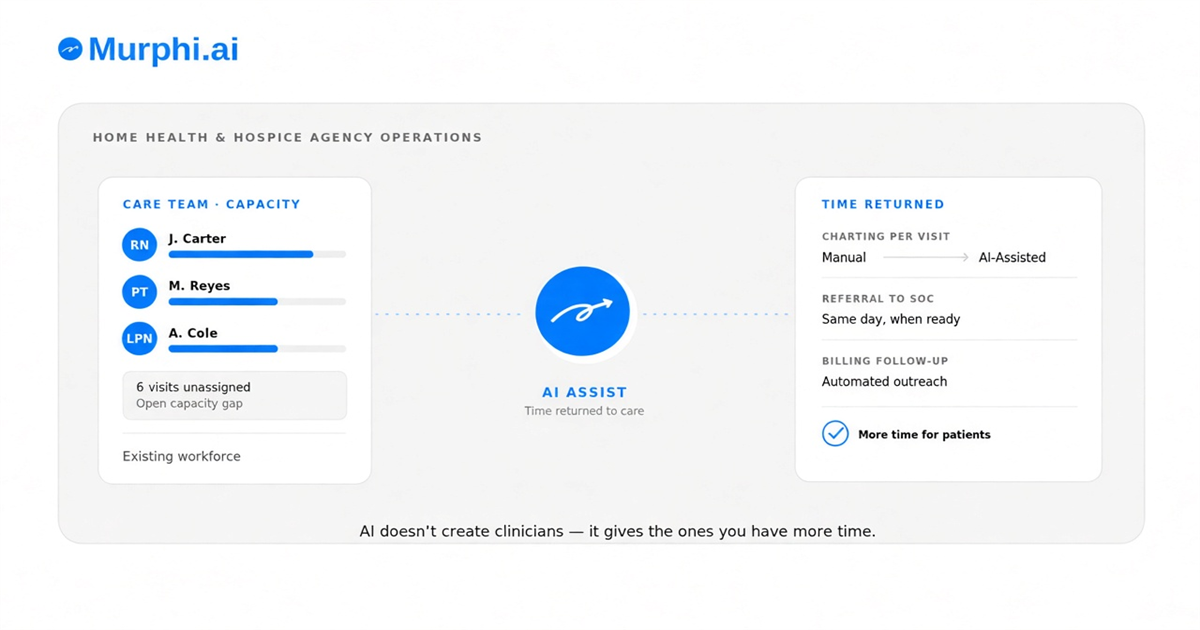
The honest answer is: partially, and specifically. AI can meaningfully reduce the administrative and documentation burden that eats into clinician time in home health, which effectively increases how much of each existing clinician's day goes to patient care instead of paperwork. What AI cannot do is create more nurses and aides, fix the wage gap that pulls clinicians toward acute care, or solve retention on its own. The staffing shortage is a labor supply problem; AI is, at best, a capacity and efficiency tool that helps agencies get more out of the workforce they already have.
How Severe Is the Home Health Staffing Shortage, Really?
It's severe and well-documented, though the exact numbers vary by source and region. A few concrete data points:
- The U.S. Bureau of Labor Statistics projects home health and personal care aide employment will grow 17% from 2024 to 2034, with more than 765,000 openings per year on average when replacement needs are included, alongside continued growth in registered nurse demand, adding roughly 195,000 openings annually across the broader nursing workforce.
- A University of Pennsylvania Leonard Davis Institute study found that over 30% of full-time registered nurses and about 25% of licensed practical nurses left their position at a large home health agency over the course of a single year, a turnover rate that illustrates how retention, not just hiring, is a core part of the problem.
- Texas's 2024 Home Health and Hospice Care Nurse Staffing Study (a state-level survey, not a national figure) found a statewide RN position vacancy rate of 14.2%, down from 16.3% in 2022, but still a meaningful share of positions unfilled at any given time.
These figures come from different populations and shouldn't be averaged together into a single national number, but they consistently point the same direction: demand for home health labor is outpacing supply, and turnover compounds the gap that hiring alone creates.
Why Home Health Staffing Is Especially Hard to Solve by Hiring Alone
A few structural factors make this shortage harder to fix than simply posting more job openings:
- The workforce is geographically dispersed, with drive time between visits eating into a clinician's productive hours in a way that doesn't apply to facility-based care.
- Home health and hospice compete with acute care and other settings for the same pool of nurses and aides, often without matching acute-care compensation.
- Documentation demands extend the workday. A visit doesn't end when the clinician leaves the home; completing OASIS and discipline notes afterward is a well-known contributor to the kind of after-hours workload that drives burnout and, eventually, attrition.
- Turnover compounds the shortage. Every clinician who leaves takes institutional knowledge and caseload capacity with them, and the agency is back to competing for the same limited hiring pool to replace them.
What Can AI Actually Do About It?
AI's realistic contribution to the staffing shortage is giving back time, not creating clinicians. A few specific ways this shows up in home health operations:
- Reducing documentation time per visit. Ambient AI tools that capture a visit and draft the OASIS or discipline note reduce the after-hours charting load that's a known contributor to clinician burnout, freeing up hours that would otherwise go to paperwork rather than additional patient capacity or personal time.
- Speeding up referral-to-start-of-care. When referral intake is slow, existing clinician capacity sits idle waiting for a case to be ready to schedule. Automating the intake and compliance-check steps means the clinicians an agency already has can start seeing patients sooner, rather than the delay compounding an already tight caseload.
- Reducing billing and collections busywork. Automating patient balance outreach and reconciliation reduces the manual load on office and billing staff, who are subject to the same hiring market pressure as clinical staff, just for administrative roles.
- Catching claim issues before they become denials. Less time spent on denial rework and appeals means RCM and billing staff can absorb more volume without proportional headcount growth.
None of this adds a single nurse or aide to the labor market. What it does is change how much of an existing clinician's or staff member's time is spent on the parts of the job that don't require their clinical judgment or administrative expertise.
What AI Can't Do About the Staffing Shortage
To be direct about the limits:
- AI doesn't create supply. It can't produce more trained nurses, aides, or therapists; that's a function of nursing school capacity, wages, and career-path decisions AI has no influence over.
- AI doesn't fix the compensation gap that pulls clinicians toward acute care or other settings with higher pay or more predictable hours.
- AI doesn't replace hands-on care. Nothing about ambient documentation, referral automation, or claims review substitutes for a clinician physically present in a patient's home.
- AI addresses one driver of burnout, not all of them. Documentation burden is a real and well-understood contributor to attrition, but it's not the only one: caseload size, on-call demands, and compensation all play a role that technology alone doesn't resolve.
So, Can AI Actually Help?
Yes. Specifically by increasing the effective capacity of the clinicians and staff an agency already has, not by solving hiring or retention directly. Agencies that get the most benefit tend to treat AI as one lever alongside workforce strategy (competitive pay, manageable caseloads, career development) rather than a substitute for it. The realistic framing isn't "AI solves the staffing shortage." It's "AI reduces how much of a scarce clinician's time gets consumed by work that isn't actually patient care", which matters, but is a narrower and more honest claim.
Where Murphi Fits Into This
To be clear about scope: Murphi doesn't offer scheduling or staffing-matching tools, and nothing here should be read as a claim that it addresses recruitment or retention directly. What Murphi's modules are built to do is reduce the administrative time tax around patient care: Ambient AI & Dictation reduces documentation time during and after visits; Referral → NOA and AI-Driven RCM, both in active development and not yet generally available, are designed to reduce time spent on intake delays and denial rework respectively; and Patient Payments reduces manual billing follow-up. Each is a piece of the "give time back" side of this question, not a staffing solution on its own.
Frequently Asked Questions
Is there really a home health staffing shortage?
Yes. Bureau of Labor Statistics projections show substantial ongoing growth in demand for home health aides and registered nurses, and separate research has documented high annual turnover at home health agencies; both hiring and retention are contributing to the gap.
Can AI solve the home health staffing shortage?
Not on its own. AI can reduce the administrative and documentation burden that consumes clinician time, effectively increasing capacity within an agency's existing workforce, but it cannot create more nurses or aides or fix the compensation and burnout factors driving turnover.
How does AI reduce administrative burden for home health clinicians?
AI tools can capture a visit and draft structured documentation automatically, reducing the after-hours charting that extends a clinician's workday, and can speed up referral processing and billing tasks so less staff time goes to manual administrative work.
Does AI replace home health nurses or aides?
No. AI tools in home health are generally built to assist with documentation, intake, and billing tasks; the clinical care itself, and the judgment behind it, remains entirely with human clinicians.
What should agencies do about staffing shortages besides adopting AI?
Workforce strategies like competitive compensation, manageable caseloads, and clear career development remain central to addressing hiring and retention. AI can complement these efforts by reducing administrative burden, but it isn't a substitute for them.
Give Existing Clinicians Time Back
Murphi reduces the documentation, intake, and billing work that eats into clinician and staff time, so the people you already have can spend more of their day on patient care.