
Patient & Family Engagement
Why Home Health Agencies Are Replacing Phone Reminders With Text Messaging
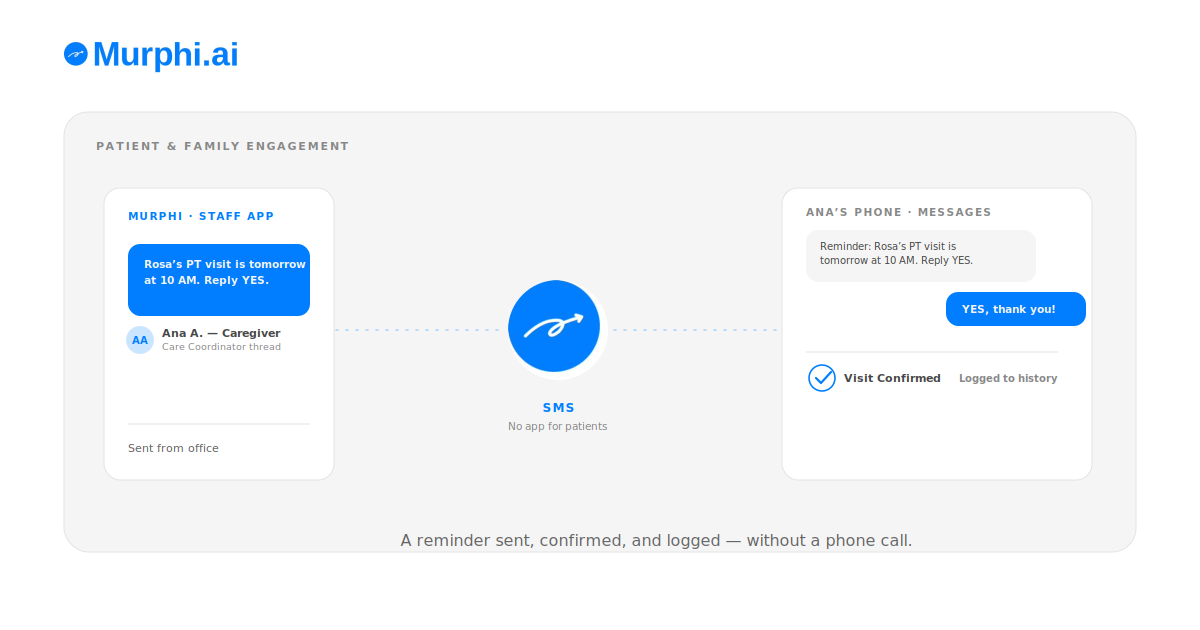
Home health text reminders are automated or staff-sent text messages that notify patients and caregivers about an upcoming visit and ask for a quick reply to confirm it. Agencies are increasingly using them in place of phone-call reminders because a text doesn't require anyone to be available at the moment it arrives, it creates a written record of whether it was seen and confirmed, and it reaches whichever caregiver is actually managing the patient's schedule, not just whoever happens to pick up the phone.
What Are Home Health Text Reminders?
A home health text reminder is a short SMS message sent ahead of a scheduled visit, typically stating the discipline, date, and time, and asking the recipient to reply to confirm. Unlike a phone call, which requires both parties to connect in real time, a text sits in the recipient's messages until they're free to read and respond, which is often within minutes, given how consistently people check text messages compared to how often they answer calls from unfamiliar numbers.
Text reminders can go to the patient directly, to a caregiver or family member managing the patient's care, or to both, depending on who the agency has on file as the point of contact.
Why Are Home Health Agencies Moving From Phone Calls to Text Messaging?
Phone-based reminders depend on someone being reachable at the exact moment the call is placed; texting doesn't. A few practical reasons agencies are making the shift:
- Calls that go to voicemail don't confirm anything. A missed call requires a callback, and if that callback doesn't happen, the office still doesn't know whether the visit is expected.
- Texting reaches the person who's actually available. A working caregiver, a patient who has trouble hearing on the phone, or a family member coordinating care from a distance can all read and reply to a text on their own schedule.
- A text reply is a written record. "Reply C to confirm" creates a timestamped, auditable confirmation; a phone call that goes through leaves no such record unless someone manually logs it.
- One staff member can send far more reminders by text than by call. Placing and waiting on individual phone calls doesn't scale the same way a batch of reminder texts does.
- It reduces unnecessary phone tag. Calls that go back and forth (office calls, no answer, caregiver calls back, office is on another line) are largely eliminated when the exchange happens over text instead.
How Text Reminders Help Home Health Agencies
Appointment Reminders
A text sent ahead of a visit gives the patient or caregiver advance notice without requiring them to answer a call in real time, and because it's written, the date and time aren't subject to being misheard or forgotten from a verbal call.
Visit Confirmations
Asking for a simple reply ("Reply C to confirm" or similar) turns a one-way reminder into a two-way confirmation loop, so the office knows the visit is expected rather than assuming it is because the reminder was sent.
Patient and Family Communication
Home health care regularly involves a caregiver who isn't the patient: an adult child, a spouse, a home aide. Texting lets the agency reach whichever contact is actually coordinating the visit, and lets that person ask a quick question back (e.g., flagging a symptom before the visit) without placing a separate call.
Reducing Missed Visits
A visit is more likely to be missed when nobody on either side realizes there's a mismatch in expectations until the clinician is already at the door. A confirmed (or promptly rescheduled) text exchange closes that gap before it becomes a wasted trip.
Improving Responsiveness
Because text replies come back asynchronously and are visible to staff as they arrive, an office can respond to a caregiver's question or a reschedule request without playing phone tag, often faster than a callback would happen.
Keeping Patients and Families Informed
Text threads can carry more than one reminder over time, giving families a running, referenceable record of what's been scheduled and confirmed, rather than relying on memory from a call that happened days earlier.
Can Text Messaging Reduce Missed Home Health Visits?
Text messaging can reduce missed visits by closing the confirmation gap that phone calls often leave open: a text sits until it's read and answered, rather than depending on both parties connecting live. When a reminder goes unanswered, that's itself a signal the office can act on before the visit, rather than finding out only when a clinician arrives to an empty house. This doesn't eliminate missed visits caused by other factors (a medical emergency, a scheduling conflict that comes up last minute), but it does address the specific failure mode where a reminder was "sent" by phone but never actually reached or was confirmed by anyone.
What Should a Home Health Text Reminder Include?
A clear, useful reminder text generally includes:
- Who it's from - the agency's name, so the recipient recognizes the sender immediately.
- What visit it's about - the discipline (SN, PT, OT, etc.) when relevant, so the recipient knows which service is coming.
- When - a specific date and time.
- A simple way to respond - a one-word or one-tap reply option to confirm, and a clear alternative if they need to reschedule.
- Minimal protected health information in the message itself - enough detail to be useful without putting unnecessary clinical detail in a plain SMS thread.
Are Text Reminders Better Than Phone Calls for Every Situation?
No. Text reminders work best for routine, logistical communication, not for clinical conversations or anything requiring real-time judgment. A phone call (or an in-person conversation) is still the right channel when a situation is urgent, when a patient or caregiver has a hearing, vision, or literacy need that makes text impractical, or when the conversation itself is clinical rather than logistical; texting is well-suited to "is this visit still happening," not to relaying a change in a care plan. Most agencies that adopt texting use it alongside phone calls rather than as a full replacement, reserving calls for the conversations that actually need one.
How Murphi Supports Text-Based Patient and Family Communication
Murphi's Patient Engagement module is built around this exact shift: staff communicate through a secure Murphi app, while patients and caregivers reply using ordinary text messages: no app download or portal login required on their end. Visit confirmation reminders can go out automatically, and replies route back to staff inside the same thread. The module also supports group and broadcast messaging for reaching a whole caseload or family thread at once, and keeps a complete, auditable communication history, including visibility into what's been read and how quickly staff responded. It's HIPAA compliant and SOC 2 audited.
Frequently Asked Questions
What are home health text reminders?
Home health text reminders are SMS messages sent to patients or caregivers ahead of a scheduled visit, typically stating the date, time, and discipline, and asking for a quick reply to confirm. They're used in place of, or alongside, phone-call reminders.
Why are home health agencies using text reminders instead of phone calls?
Text reminders don't require the recipient to be available at the moment they're sent, they create a written confirmation record, and they reach whichever caregiver is actually managing the patient's schedule. Phone calls that go unanswered leave no such record and require a callback to resolve.
Can text messaging reduce missed home health visits?
Text messaging can reduce missed visits by turning a one-way reminder into a two-way confirmation: an unanswered text is a visible signal the office can act on before the visit, rather than discovering a mismatch only when the clinician arrives.
What should a home health text reminder include?
A good reminder includes the agency's name, the type of visit, the date and time, and a simple way to reply (such as a one-word confirmation and a clear option to reschedule) while keeping detailed protected health information out of the message itself.
Are text reminders better than phone calls for every situation?
No. Text reminders work well for routine scheduling and confirmations, but phone calls remain the better channel for urgent situations, clinical conversations, or when a patient or caregiver has a communication need that makes texting impractical.
Let Families Text Instead of Call
Staff message from a secure Murphi app. Patients and caregivers keep texting the way they already do: no download, no portal password.