
Coding, Billing & Consulting Partners
Scaling a Home Health Coding & Billing Consultancy Without Adding Headcount
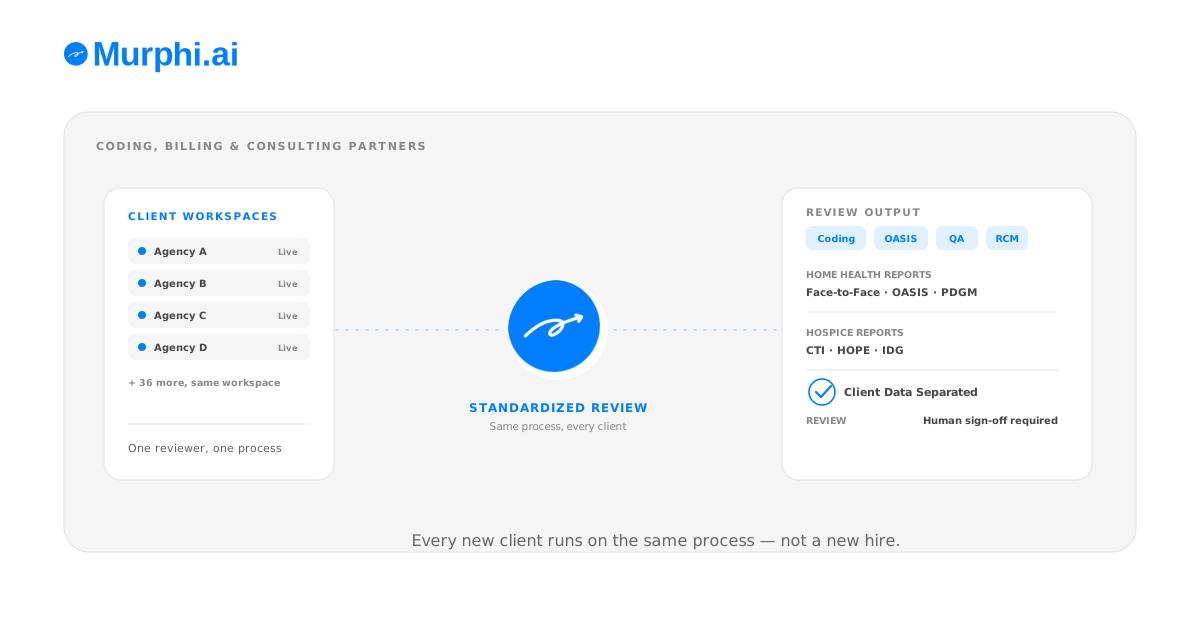
Scaling a coding and billing consultancy "without adding headcount" means taking on more agency clients without needing to hire a proportional number of new reviewers to keep up. In the traditional model, each new client adds another full set of charts that has to be read manually, which means client growth and headcount growth move together almost one-to-one. The alternative isn't working faster; it's standardizing the review process itself so it doesn't depend on adding a person for every new client.
Why Headcount Usually Has to Grow With Client Count
In a manual review model, client growth and staffing growth are tightly linked, because the bottleneck is reviewer time, not client demand. A few consequences of that link:
- Every new client adds a proportional review workload. There's no way around reading each client's OASIS, coding, and compliance documentation without the hours that takes.
- Review quality can drift depending on staffing. Whoever happens to be covering a given client's charts that week may apply the process slightly differently than someone else would.
- Turnaround slows as the roster grows, since the same finite reviewer capacity is now split across more clients.
- Each client's reporting often gets assembled from scratch, without a standardized format that would let the process itself scale independent of who's doing it.
What "Scaling Without Headcount" Actually Requires
Getting client growth and headcount growth to decouple generally requires a few specific things:
- A standardized review process that produces the same output regardless of which staff member, or how many, are involved.
- Automation of the repetitive parts of chart analysis, so reviewer time is spent on judgment calls and exceptions rather than reading every line of every chart from scratch.
- Reliable client data separation, so growth in client count doesn't create cross-contamination risk between competing or unrelated agencies on the same platform.
- A consistent onboarding process for new clients, so adding client forty-one looks like adding client two, not a custom project.
Two Operating Models for a Growing Consultancy
Consultancies generally scale using one of two models, depending on how much control they want over the client relationship:
- Managed services. The consultant logs into the platform, pulls up each client's data, runs the compliance and coding reports, and delivers results directly. This keeps the consultant in control of the workflow and the client relationship, but review volume still scales with the consultant's own hours.
- Self-service agency access. Each client gets its own workspace and runs its own reports, with the consultant providing oversight, training, and guidance rather than running every report personally. This is the model that most directly decouples client count from consultant hours, since clients handle their own report generation.
Many consultancies use a mix (managed services for higher-touch clients, self-service for clients comfortable running their own reports) rather than committing entirely to one model.
What a Coding & Billing Consultancy Can Standardize With AI-Assisted Review
Standardization works best when it's applied to the specific, recurring review categories that make up most of a consultancy's workload. For home health clients, that typically includes reviews like face-to-face documentation, OASIS accuracy, coding review, ADR preparation, PDGM optimization, and recertification validation. For hospice clients, the equivalent set includes reviews like CTI validation, HOPE assessment review, and IDG documentation. Standardizing these specific, recurring review types, rather than treating every client's chart review as a bespoke exercise, is what allows the same process to run consistently whether a consultancy has five clients or fifty.
AI-Assisted Review Still Needs a Human in the Loop
AI-assisted chart review is designed to reduce the manual reading burden, not to remove professional judgment from the review. This matters both practically and as a matter of how these tools are built to work: AI-generated coding suggestions, OASIS scoring recommendations, and compliance findings are informational and assistive; they're built to support a qualified reviewer's judgment, not to replace it, and responsible use requires independent professional review before anything reaches a client. On the accuracy side, Murphi's own platform documentation describes an AI accuracy range in the 90–95% band across its reports, paired explicitly with a structured human review workflow: the accuracy figure and the review requirement are presented together, not as a substitute for one another. No AI review tool, including Murphi's, should be treated as a guarantee of coding accuracy, scoring accuracy, or reimbursement outcomes.
What About White-Labeling?
Offering AI-assisted review under a consultancy's own brand, rather than a client seeing a third-party platform's name, is a natural extension of scaling a practice's identity alongside its client base. Murphi's white-label option, which would let a consultancy's clients see the consultancy's own branding while Murphi's AI runs in the background, is not yet generally available; it's listed as a forthcoming option on Murphi's platform rather than a live feature today.
What Client-Level Data Separation Actually Means for Multi-Client Consultancies
Running many agency clients through one platform only works if each client's data stays fully separated from every other client's, including from other clients that may be direct competitors. This isn't just a HIPAA consideration, though it certainly includes one; it's also a basic trust requirement for the consulting relationship itself. A platform built for multi-client use should maintain that separation structurally, not rely on staff discipline alone to keep client data apart.
Frequently Asked Questions
What does "scaling without adding headcount" mean for a coding and billing consultancy?
It means growing the number of agency clients a consultancy serves without needing to hire a proportional number of new reviewers, achieved by standardizing the review process and automating the repetitive parts of chart analysis, rather than simply working existing staff harder.
Can one consultant realistically manage compliance review for dozens of agency clients?
It depends heavily on the operating model. A self-service model, where clients run their own standardized reports with the consultant providing oversight, scales more easily across many clients than a managed-services model where the consultant personally runs every report.
What's the difference between a managed-services and self-service model for consulting clients?
In managed services, the consultant runs reports and delivers results directly, keeping full control of the relationship. In self-service, each client runs its own reports in its own workspace, with the consultant providing training and oversight rather than handling every report personally.
Does AI review replace the need for a certified coder or compliance reviewer?
No. AI-assisted review tools are built to support a qualified reviewer's judgment by handling repetitive analysis, not to replace independent professional review; coding suggestions and compliance findings still require a qualified person to review them before they reach a client.
Can a consultancy offer AI-powered review under its own brand?
Some platforms offer white-labeling so a consultancy's clients see the consultancy's own brand rather than the underlying technology provider. Availability varies by platform and may be a forthcoming rather than current option; confirm current availability directly with any vendor you're evaluating.
Make Every New Client Look Like Client One
Murphi gives coding and billing consultants AI-powered compliance and revenue tools that work the same way across every client: home health and hospice, managed or self-service, with client data kept separated throughout.