
Patient Payments & Collections
Text-to-Pay for Home Health: How It Works and Why Patients Prefer It
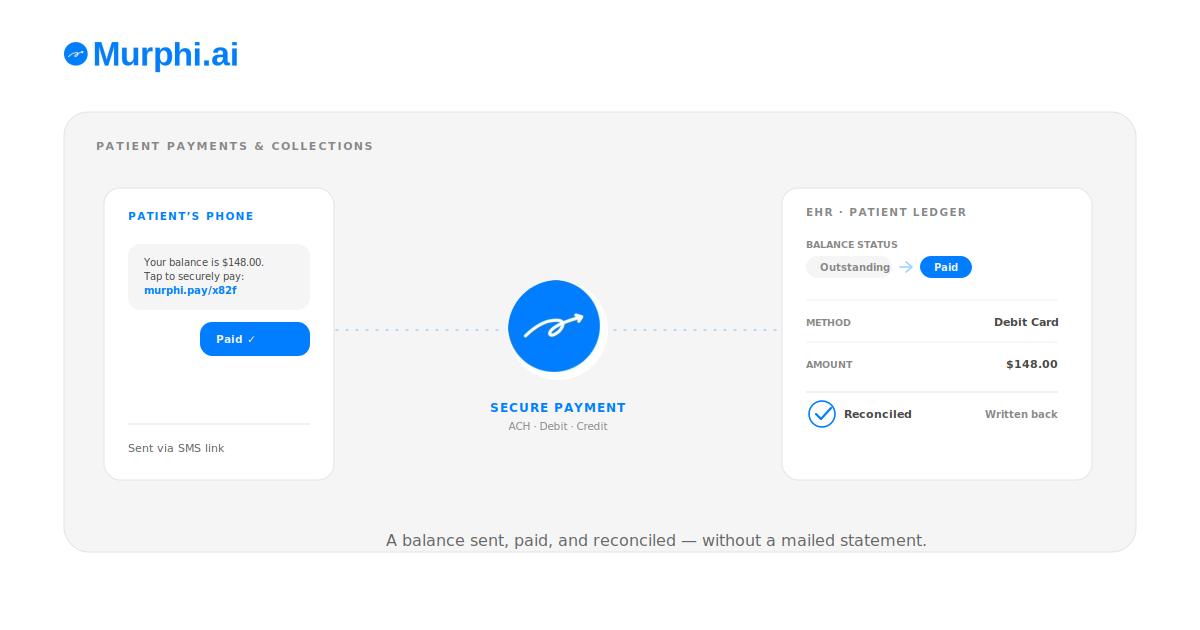
Text-to-pay is a billing method where a patient's outstanding balance is sent as a text message containing a secure payment link, letting them pay by ACH, debit, or credit card directly from their phone, instead of waiting on a mailed paper statement. Home health agencies are adopting it because it removes most of the delay built into paper billing: no printing, no mail transit time, and no waiting on a check to arrive and clear.
What Is Text-to-Pay for Home Health?
Text-to-pay is the practice of notifying a patient about a balance they owe through a text message rather than a mailed statement, with a secure link inside that message that takes them directly to a page where they can pay. The balance itself is identified the same way it always would be, from the agency's billing or EHR system, but the notification and payment step happen over SMS instead of postal mail and phone calls.
How Does Text-to-Pay Actually Work?
A text-to-pay flow for home health billing generally follows five steps:
- Balance identified. The patient-responsibility balance is pulled from the agency's existing system.
- Automated outreach. A text message is sent to the patient (or responsible party) containing a secure payment link.
- Patient pays. The patient opens the link and pays using ACH, debit card, or credit card. No separate account or app download required.
- Status updates. The balance status changes from outstanding to paid as soon as the payment is processed.
- Reconciliation. The payment is matched back to the correct account and the ledger is updated, without a staff member manually cross-referencing a mailed check against an invoice.
Mailed Statement vs. Text-to-Pay
| Mailed Statement | Text-to-Pay | |
|---|---|---|
| Notification | Printed, folded, and mailed | Sent as a text message |
| Time to reach patient | Days, depending on mail transit | Immediate |
| How the patient pays | Mails a check back, or calls the office | Taps a secure link and pays from their phone |
| Reconciliation | Staff manually match the payment to the ledger | Payment status updates and reconciles automatically |
| Typical resolution time | Often two to three weeks | Can be resolved same-day |
Why Do Patients Prefer Text-to-Pay Over Traditional Billing?
Patients generally prefer text-to-pay because it removes steps rather than adding them: there's no check to write, no envelope to find, and no need to remember to mail anything before a due date. A few reasons this tends to be true for home health billing specifically:
- It meets patients where they already are. Most people read a text message far sooner than they open a piece of mail, especially mail that looks like a bill.
- Paying takes a few taps, not a multi-step process. There's no need to locate a checkbook, find a stamp, or remember to drop it in the mail.
- No new account or app to set up. The link goes directly to a payment page, rather than requiring the patient to register for a portal first.
- It's harder to lose than a paper statement. A text stays in a phone's message history; a paper statement can get set aside and forgotten.
How Text-to-Pay Reduces Administrative Work for Billing Teams
Beyond the patient experience, text-to-pay changes the work on the agency side:
- Outreach doesn't require manual printing or mailing. The message goes out automatically once a balance is identified.
- Reconciliation doesn't require manual matching. When a payment comes in, it's tied back to the correct balance and the ledger updates without someone cross-checking a mailed check.
- Outstanding balances stay visible. Billing staff can see what's been sent and what's still unpaid, rather than waiting to find out only when a check does or doesn't arrive.
Is Text-to-Pay Secure and Compliant?
Yes, when it runs through a properly built payment gateway: text-to-pay for healthcare should be PCI-compliant for card and ACH processing and handled in a HIPAA-compatible way. The agency (or its software vendor) should not need to store card numbers directly, and the platform facilitating the payment should not hold provider funds itself; payments should settle directly to the provider's own bank account. Agencies evaluating a text-to-pay vendor should confirm exactly how funds settle, how quickly, and whether the vendor is PCI-compliant before rolling it out.
What Should a Home Health Text-to-Pay Message Include?
A clear text-to-pay message typically includes:
- Who it's from - the agency's name, so the patient recognizes the sender.
- The balance amount - stated plainly, so there's no need to open a separate document to find it.
- A secure, recognizable link - one the patient can trust isn't a phishing attempt.
- A simple payment flow - the fewest possible steps between opening the link and completing payment.
- Accepted payment methods - so the patient knows upfront whether ACH, debit, and credit are all available.
Frequently Asked Questions
What is text-to-pay for home health?
Text-to-pay is a billing method where a patient's outstanding balance is sent as a text message with a secure payment link, allowing the patient to pay by ACH, debit, or credit card directly from their phone instead of mailing a check in response to a paper statement.
Why are home health agencies using text-to-pay?
Agencies are adopting text-to-pay because it removes the delay built into mailed billing (no print and mail time, no waiting on a mailed check) and because it reduces the manual work billing staff spend matching payments back to accounts.
How does text-to-pay improve collections?
Text-to-pay can improve collections by shortening the path between a patient being notified of a balance and actually paying it: a text with a direct payment link removes steps like writing a check or calling the office that a mailed statement requires.
Is text-to-pay secure?
Text-to-pay is secure when handled through a PCI-compliant payment gateway in a HIPAA-compatible way. The agency and its software vendor generally shouldn't store card numbers directly, and funds should settle to the provider's own bank account rather than being held by the payment platform.
What payment methods does text-to-pay support?
Most text-to-pay platforms for healthcare support ACH bank transfers, debit cards, and credit cards, letting the patient choose whichever method they prefer at the time they pay.
Stop Waiting on the Mail Truck
Murphi turns a patient balance into a text with a secure payment link (ACH, debit, or credit) with payment status and reconciliation written back to your EHR ledger automatically. Murphi facilitates the payment experience and reconciliation; it does not hold provider funds.