
Referral, Intake & NOA
What Is Notice of Admission (NOA) and Why Timing Matters
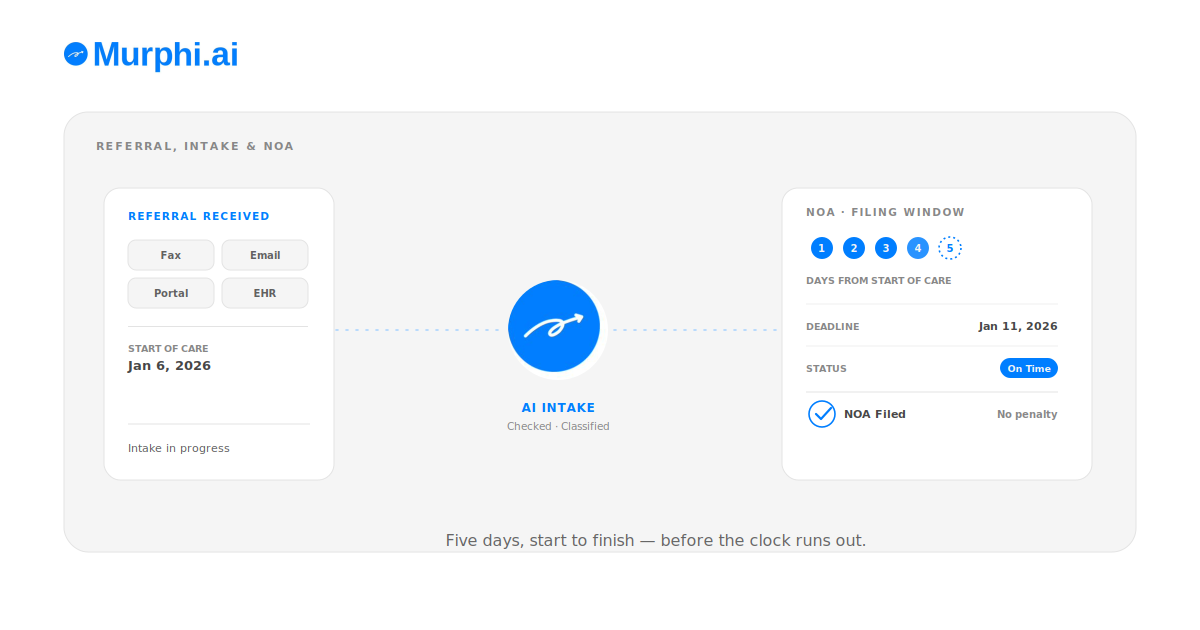
A Notice of Admission (NOA) is a one-time Medicare submission that establishes a patient's home health period of care, and it must reach the Medicare Administrative Contractor (MAC) within five calendar days of the start-of-care date; miss that window, and CMS reduces the payment for every day the NOA is late. It replaced the old Request for Anticipated Payment (RAP) process effective January 1, 2022, and unlike a RAP, no anticipated payment comes with it; it's purely the notice that starts the clock.
What Is a Notice of Admission (NOA)?
The NOA is a single, one-time submission per home health admission that tells Medicare a period of care has started, and it stays in effect across all the contiguous 30-day payment periods that follow until the patient is discharged. CMS introduced it as part of the Patient-Driven Groupings Model (PDGM) rollout, formalized in MLN Matters article MM12256, replacing the Request for Anticipated Payment (RAP) that home health agencies previously submitted at the start of each period. The core difference: a RAP came with a partial anticipated payment; the NOA does not; it's strictly the notice that opens the period of care, with payment happening through the regular claims process afterward.
How Is NOA Different From the Old RAP Process?
| RAP (pre-2022) | NOA (2022 & after) | |
|---|---|---|
| Submitted | Once per 30-day (or previously 60-day) period | Once per admission, covering all subsequent periods until discharge |
| Anticipated payment | Yes, a partial payment came with submission | No, the NOA itself carries no payment |
| Purpose | Requested upfront payment and opened the period | Establishes the period of care; payment happens through the standard claim |
| Late-filing consequence | Reduced anticipated payment | Payment reduction on the period's claim, calculated by days late |
When Must a Home Health Agency Submit the NOA?
The NOA must be submitted to, and accepted by, the MAC within five calendar days of the start-of-care date to be considered timely-filed. The five-day count begins the day after the start-of-care/admission date. What counts for timeliness is the date the NOA was received by the MAC, not the date it finishes processing or is formally accepted, which can happen slightly later.
What Happens If the NOA Is Late?
A late NOA triggers a payment reduction equal to 1/30th of the wage-adjusted 30-day period payment for every day between the start-of-care date and the date the NOA is actually submitted. A few specifics worth knowing:
- The reduction scales with how late it is. An NOA submitted on day 6, for example, is one day late and triggers roughly a 1/30th reduction; the longer the delay, the larger the cumulative reduction.
- It applies to outlier and LUPA claims too. For periods that would otherwise qualify for a Low-Utilization Payment Adjustment, no per-visit LUPA payment is made for visits that occurred before the NOA was submitted.
- It's a provider liability. The agency absorbs the reduction; it cannot bill the patient for the difference.
- Exceptions exist, but they aren't automatic. CMS may waive the penalty for exceptional circumstances, but the agency has to request the exception and meet the documented criteria; routine delays don't qualify.
Source: CMS MLN Matters MM12256, "Replacing Home Health Request for Anticipated Payment (RAP) with Notice of Admission (NOA)". Agencies should confirm current-year specifics (such as any MAC-specific processing guidance) directly against CMS and their MAC's published materials, since claims-processing bulletins are updated periodically.
Why Does NOA Timing Matter Operationally?
The five-day NOA clock starts at the start-of-care date, which means everything that has to happen before an NOA can be filed (accepting the referral, confirming the face-to-face encounter and physician order, verifying eligibility) has to happen fast enough to leave room to submit it. A referral that sits unprocessed over a weekend, or an intake team that's still chasing down a missing signature on day 4, isn't just a documentation delay; it's actively eating into the filing window before the NOA has even been prepared. NOA timing is ultimately a downstream consequence of how quickly and cleanly referral intake happens, not just a billing-team deadline.
What Can Agencies Do to Avoid Late NOA Penalties?
A few practices that reduce late-NOA risk:
- Track the due date the moment a start-of-care date is set - SOC date plus five calendar days, treated as a hard deadline from day one, not calculated after the fact.
- Resolve intake gaps quickly. A missing face-to-face order or an incomplete referral shouldn't be allowed to sit unresolved while the five-day window keeps running.
- Don't wait for a "complete" chart to submit. The NOA only needs to establish the period of care; it doesn't require every piece of documentation to be finalized first.
- Reserve the exception process for genuinely exceptional situations, since CMS doesn't grant waivers for routine processing delays.
- Review late NOAs after the fact to identify whether the same bottleneck (a referral source, a specific document type, a particular day of the week) keeps causing the delay.
How Murphi Supports Faster, Cleaner Referral-to-NOA Intake
Murphi's Referral → NOA module is in active development and not yet generally available; this section reflects the planned workflow, and capabilities may change before launch. As designed, it brings referrals in from fax, email, portal, API, or EHR into one AI intake dashboard, classifies and extracts the patient and referral information automatically, and runs completeness, face-to-face, order, and eligibility checks together rather than one at a time. Intake staff still make the accept, pending, or decline decision; accepted referrals are designed to write directly into the EHR, ready for start-of-care scheduling and NOA filing. Home Health and Hospice intake are kept separate: NOA is Home Health terminology, and Hospice referral and intake use their own appropriate terms rather than being labeled NOA.
Frequently Asked Questions
What is a Notice of Admission (NOA) in home health?
An NOA is a one-time Medicare submission that establishes a home health patient's period of care. It replaced the Request for Anticipated Payment (RAP) effective January 1, 2022, and remains in effect across all contiguous 30-day payment periods until the patient is discharged.
How long do agencies have to submit an NOA?
Agencies have five calendar days from the start-of-care date to submit the NOA and have it received by the Medicare Administrative Contractor for it to be considered timely-filed. The count begins the day after the start-of-care date.
What happens if a home health NOA is submitted late?
A late NOA triggers a payment reduction equal to 1/30th of the wage-adjusted 30-day period payment for each day between the start-of-care date and the date the NOA is actually submitted. The reduction is a provider liability and cannot be billed to the patient.
Is the NOA the same as the old RAP (Request for Anticipated Payment)?
No. A RAP was submitted each period and came with a partial anticipated payment. The NOA is a single, one-time submission per admission that carries no payment itself; it simply establishes the period of care, with payment handled through the standard claims process.
Can the NOA late-filing penalty be waived?
CMS may waive the penalty in exceptional circumstances, but the waiver isn't automatic; the agency must request it and meet the documented exception criteria. Routine processing delays generally don't qualify.
See What's Coming to Referral → NOA
Murphi is building one AI intake dashboard that classifies referrals from every source, runs completeness and compliance checks together, and gets accepted referrals ready for start-of-care scheduling and NOA filing. Referral → NOA is launching soon.